Treasure Hunters

| In My Back Yard |
The view out the back
door |
A (Low) Tech Perspective |
Treasure Hunters
Treasure Hunters
I
My grandpa had a dusty
plate of seashells, dry,
and in plastic trays, a score
of tree parts, petrified;
each a hardened image
of an old, indurable thing.
(His trees had rock rings--
each marked a hundred years
of settling, from under-sea
memorials to the life of things
once living. Do they honor age
and greatness? Or mock
with minerals the fragility
of trees in their relative youth,
and old invertebrates
for their few years on earth?)
My mother also hunts for shells
and tiny priceless things
on walks outside, to fill
the permanent solo show
on the shelves around her home.
Grandpa taught us where
to start, but momma taught me art,
to revel in the fingering of stone
until it shone from human touch
and time.
Some will even grind
these rocks up into jewels,
to reveal the deeper secrets
and unhide the truer themes
of what the earth wrings
by pressure from simple dust
and ancient buried dreams.
II
I also collect things, and find
that I inherited the eye,
though I don't often get the time
to walk the wilds, to discover old
bones and gems by ancient trails,
outside.
Today, I’m a panner
for urban gold—my claim spans
the blocks, and mines the old
and ever-rising asphalt-mantled
roads; I sift the grit and duff
that cruft and clog the binding
slough, that fill the cracks that jog
across the busted walks that sit
beside the avenues.
In fact,
in cities … I don't mind the trees,
nor always wish for grassy fields.
No. I take this place for what it is:
a forest of human things that rise
and stand; some parts designed
to last, to resist the wear of wind
and water, and some to be replaced
as fast as the shifting of the weather.
Along this breaking beach I walk,
between the rising dreams of men,
who’s trophies scratch at heaven,
and the crashing waves of time,
that grind to sand the things
our hands have brought to life.
Here, what was so wonderful
and clear succumbs to the craft
of years, rarely to become
embalmed, and allowed to stay,
enshrined or ennobled
by what’s been taken away.
It’s trash —okay! If you insist
on seeing it that way.
It's bottle caps and broken glass,
car parts, and other shards
of ancient, manufactured things—
once skipped along suburban
streams, now fractured and settling
into dusty pools and poisonous
eddies that collect where raging
urban rivers intersect.
Here, even ugly things are
made to gleam: iron and her
alloys are redeemed—abraded,
ground and buffed by water
and time, to pock and rough
the surface, hastening
the inevitable blush of rust,
and other signs of softening
that time conveys to human stuff ...
here, also, trucks by rubber pestle
cast-offs into jewels against
the mortar of our gritty, ribboned,
urban tracks.
Here, nature keeps
her eye on man, to shame the vanity
of our shiny plans. Though trees and clams
seem happy to be reduced to stone,
we resist, pretend that we don’t know
that humankind is aging also: getting
harder in the heart, and each year
softer in the gut.
Meantime,
mama gathers up our proud inanimates
in bits and pieces to her mantle,
to polish, corrode, and make
more precious our ignoble junk,
and claim for glory countless things
that we, neglectful, send
to the icy bottom of her ancient sea,
where in her cleansing stream,
she rehearses an old and dusty dream.
![]() Natural Wonders
An ongoing project to capture how artificial things weather and decay beautifully, evoking natural patterns.
Labels: art The Year In Collage![]() Gallery Functional 3D Collage
A collage from found stuff that does things and sounds neat.
This is a home-brew, low-tech iPhone amp made of PVC pipe and an old bike horn. It adds a little oomph, without powered amplification. It works well, tho it amplifies some frequencies better than others (like vocals). The bike horn (with it's noise maker removed) had just the right amount of threading on the end to screw into the soft plastic hole, and be flush with the inside of the PVC. It sits directly in front of the tiny mono speaker. Leaving the ends of the pipe open allows for a more expansive sound and lets more treble escape. The weight of the horn keeps the phone from tipping back. I love that this re-purposes something that has been sitting around my house as a pretty object (the horn, not the iPhone). It has real functional purpose too, if we want to listen to a little music while sitting outside with a cup of coffee, for example. Collage "Sketches"
Pages from a small notebook that I fill with 'sketches' in collage: usually, two or three images stuck together when I can't get my brain going for larger, more complicated pieces. Sometimes simply a place to put the too-small collage. But I love a lot of what happens in this little book.
Collage Sketchbook New Collages
New Collages, from late 2009
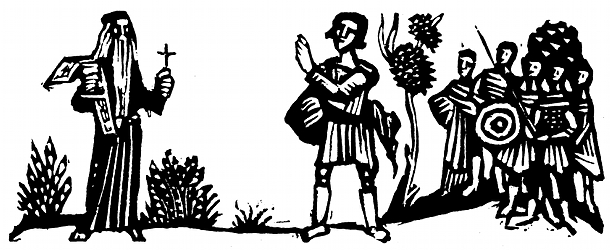
If you are interested in purchasing an original of any of these collages, drop me a line. The Warrior / PriestThis is a woodcut made by my wife's grandfather: Spyros Vassiliou was (until his death in 1984) a great artist, and was a part of an important community of Greek painters in the middle of the 20th century. He also designed sets and costumes for the theater, which is how he met my father-in-law, a playwright from Yale who ended up marrying the painter's daughter. My wife was the first child of that union, and met me in the theater department at Bennington College. And that's pretty much how I came to be in possession of the above woodcut. I love Spyros' paintings, but I love his woodcuts even more. The artist turned to wood during World War II, when painting supplies were scarce, and during a time when the Germans occupied Greece (the German military had, in fact, a kind of base of operations in the old house that became my wife's family's home). The woodcuts are simple and display big symbolic themes (freedom, hope, peace, etc), as you'd expect from a war-time body of work. But the woodcut above is entirely unique in the collection. It shows a Greek ship in a storm, which itself is not unique in a maritime culture. What is unique is that the ship is covered with devils who are threatening to tear the ship to bits, as if the storm was not enough of a threat. Also surprising is that the picture-story is not about brave Greek sailors fighting to save the ship, but about an old priest who stands in the scene praying. Now, I understood this artist to be, like most Greeks, only culturally Christian, even though he was commissioned to paint the interiors of several orthodox churches: there is little sign in his work (or in his family line, I'm sorry to say) of a vibrant faith. But what am I to make of this picture? This is a picture that betrays a faithful vision. Where did this painter get the idea that priests are warriors? Let's not focus unfairly on Greece, or on the orthodox countries: in no country do priests or pastors tend to reveal themselves to be more than quiet and somewhat harmless participants in society, who know their place. I'm not aware of any stories of bravery among the Greek priesthood during the war, and anyway, this is not that kind of militant courage. It takes a different kind of vision to see the true occupation of the priest-who-is-also-a-warrior. The ship in the image is a symbol for the church, of course, and this priest is not just fighting the only fight that a priest is suited for, but the only real fight there is. St. Paul writes in his letter to the Ephesian Christians that, "Our struggle is not against flesh and blood, but against the ... world forces of ... darkness, against the spiritual forces of wickedness in the heavenly places." This woodcut is a really cool depiction of the hidden power of the priest. What is equally exciting to me, is that this artist, great-grandfather to my son and daughter, seems to understand that the church is more than capable of surviving rough water ... and that the wise priest sees, with the eyes of the spirit, that the danger to a ship is never really the storm itself, but those forces that threaten to reduce the seaworthiness of the vessel. Labels: art portraits in collageNew Collages
Some new works, including new notebook covers. Other recent works were inspired by the lyrics of a musician friend, Nick Bartunek of Picture Atlantic.
2008 collages ... The Thing
The Thing, the Golem, and what's at the heart of the stone
If you go to adherents.com you can learn many interesting things related to religious practice in the world, including the religious affiliation of any famous person. One of my favorite pages on this site is the list of super heroes and comic book characters. Yes, this is the place to learn that Marvel's Elektra is Greek Orthodox, Superman is Methodist/Kryptonian, X-Man Sabretooth was an atheist who saw the light ... "... Wolverine attends the funeral of [his arch-rival] Sabretooth, and learns that Sabretooth became a devout "born-again" Christian. Sabretooth's funeral was attended by scores of people who testified about how Sabretooth had touched their lives and had been an inspiration to them."Other facts obvious (Super Bahai Girl is ... Bahai) and less obvious (the character Wiccan, from the Young Avengers, is not a fan of Harry Potter, but a reformed Jew) abound. One of my favorite comic characters is The Thing (not really the slightly stupid-looking movie character from recent films, but the Jack Kirby creation). The Thing, one of the Fantastic Four, was turned to stone by some kind of space-radiation. There is something iconic in this hulking rock-man that makes me think of humankind in general (made from earth and bound by our "hearts of stone"). On The Thing's page, Adherents quotes a story about the issue where his Jewish faith is revealed ... ... Bending over the fallen [Jewish pawn broker] Sheckerberg, The Thing prays the traditional "Sh'ma Yisrael," the Hebrew confession at death. Sheckerberg survives and asks Grimm the question on many readers' minds: "All these years in the news, they never mention you're Jewish. I thought maybe you were ashamed of it a little." Grimm explains that, to the contrary, he did not want to bring shame on the Jewish community. "Figure there's enough trouble in this world without people thinkin' Jews are all monsters like me." When Grimm tries to return the stolen Star of David, the pawnbroker refuses it, likening Grimm to the Golem--the legendary living statue said to have protected Prague's persecuted Jews."Once my young son and I were trolling in our local Target: he'd saved up a few dollars and wanted to buy a toy. We saw a Thing action figure. I thought it was pretty cool and pointed it out to him. He shrugged his approval and kept looking. He had trouble making up his mind, and I kept asking him, hey what about this Thing doll? He got as firm as a six year-old can get and said that he didn't really want that one. Then I realized ... I wanted it. Hey, I have six dollars! Timo bought the giant green-foam Hulk Punching Fists with Realistic Roaring Sounds, and I bought The Thing, who still stands over my computer. Timo was stuck with me in my office one summer day, and I gave him the doll, showed him how he could push him flat against a piece of paper and draw his outline, crime-scene style. The resulting images were inspiring (to me ...), and I expanded the project. Without realizing what we were doing, and without being aware of Benjamin Grimm's Jewish story at the start, we created a kind of Old Testament Review of characters, even evoking the story of the Golem, the earth monster with a heart that is at the root of the Frankenstein story (another story with surprising theological implications). The project, as it stands, contains the original 'outlines', a freehand sketch by Timo, and a couple of the collages I've made that feature Ben Grimm. See The Thing and other heroes in the Gallery cover meI've been covering my notebooks for years. I started by scratching out brand names and logos on otherwise un-decorated journals. The habit progressed from simple stickers or fabric, to various other art attacks, collage, and occasional carving (as at left). It started simple, and it's gotten to be a regular ritual, one that is a really satisfying, encouraging, and freeing. View the gallery. Icon of The OtherFrom our Pentecost service in 2005, "Stations of Pentecost": this station was about interacting with the "other" in our midst (the station included a "Phrasebook", like you'd use to get around a foreign country). ICON OF THE OTHER "When we encounter others, we are painfully aware of the effects of our fall from grace -- sin is ever before us. We choose not to speak because we are afraid of causing offense or being misunderstood. We read judgment or anger or impatience in their faces, whether it is there or not. We have always believed that the Holy Spirit can help us know what to say, at the right time. Do we also believe that the Holy Spirit is at work in the other, translating our imperfect words into words of life?" The Phrasebook had little spurs to conversation like, "Say what you're thinking -- God has been working on your thoughts", and "Don't be afraid of what you think a person thinks (you're probably wrong)", and, "Ask an honest question about them ... you might get an honest answer". The book also had room for people to write their own thoughts about the conversation. Labels: art |
|
Copyright, Davo, 2005 through today